Room 1: Introduction
‘The post-office is a wonderful establishment!’ said [Jane Fairfax].—‘The regularity and dispatch of it! If one thinks of all that it has to do, and all that it does so well, it is really astonishing!’ Emma, 1816, volume 2, ch. 16
‘The style of her familiar correspondence was in all respects the same as that of her novels.’ Henry Austen, ‘Biographical Notice of the Author’, prefaced to Northanger Abbey, 1818
Jane Austen wrote about the world she knew. In doing so, she invented a new voice for fiction: conversational and intimate. Though early experiments in the novel, among them Austen’s own, were written as a series of fictional letters, her novels are the first to see in the ordinary domestic letter, filled with news of family and neighbours, a future for the novel as a study of life’s everyday events: dining out, drinking tea, walking to the shops, making friends, finding someone to love. Her genius lay in exposing the proximity of fiction to reality.
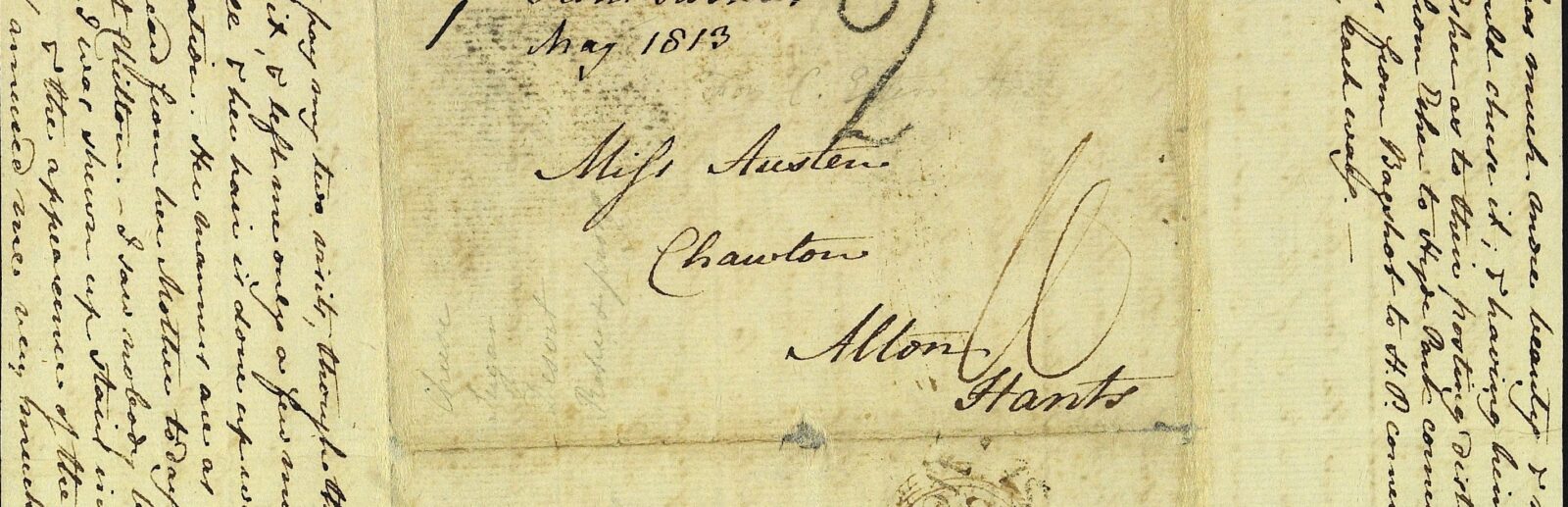
Of the thousands of letters Jane Austen probably sent, just 161 survive – her sister Cassandra destroyed many of the rest. What might they have contained? Those that remain are open letters—a mix of news, gossip, and opinion—designed to keep one family group in touch with another.
Though very many were written either from or to Chawton Cottage, now Jane Austen’s House, the originals of Austen’s letters are scattered worldwide in public and private collections. Jane Austen’s House owns just thirteen.